Your Strategic Partner in Franchise System Development.
Learn how to Franchise a Business Profitably.
Call us at: 1-800-471-1682Learn how to Franchise a Business Profitably.

Summary
You've built a business that works—now what? Franchising lets you scale without draining your own capital, but most owners don't realize it can cost under $50,000 to launch when structured correctly. Here's what separates profitable franchise systems from expensive mistakes.
Key Takeaways
Building a business that actually works is genuinely hard. Most entrepreneurs never get there. But if the concept is proven — if customers keep coming back, operations run smoothly, and the model is repeatable — then the harder question becomes: what's next? For many successful business owners, the answer is franchising. It's a path that turns one location into many, one concept into a national brand, and one owner's effort into a whole network of invested partners. The process isn't simple, but it is navigable — especially with the right roadmap.
Most people who want to expand a business focus on the wrong thing first. They think the challenge is finding the money to open new locations, hire more staff, or sign more leases. The real challenge — the one that takes years and costs the most in trial and error — is building a concept that actually works. And if that's already done, the foundation for a franchise system is already in place.
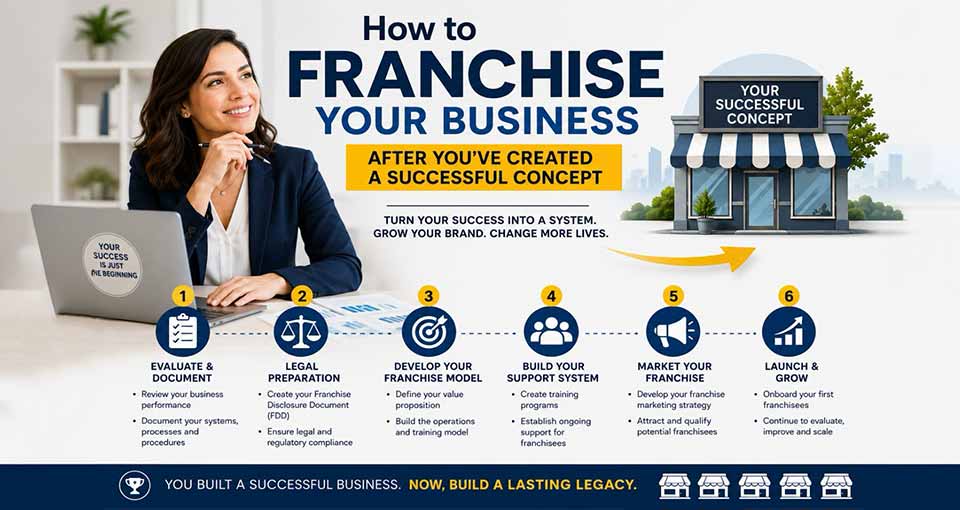
Franchising is, at its core, the act of packaging a proven business model so that other people can replicate it. The hard work of figuring out what works, what doesn't, how to price, how to serve customers, and how to run day-to-day operations has already been done. What remains is translating all of that knowledge into a system — a set of documents, processes, training programs, and legal agreements that allow someone else to run the same business with the same results.
That's not a small task, but it's a very different kind of task. It's less about invention and more about documentation, structure, and legal compliance. And it's work that doesn't have to be done alone. Franchise Growth Partners was built specifically to help business owners make this exact transition — from successful operator to functioning franchisor — without the guesswork that typically drives up costs and delays launch.
One of the first questions every prospective franchisor asks is how much this is going to cost. It's the right question, and the honest answer is: it depends — but it's far more affordable than most people assume.
Most businesses that go through the full franchise development and early sales process invest somewhere between $46,000 and $100,000 in total. That range reflects real variables: the complexity of the business model, the number of states where the franchise will be registered, whether the franchisor needs audited financials, and how much consulting and infrastructure support is built into the process.
Legal costs alone represent a significant portion of that budget. Preparing a Franchise Disclosure Document with a franchise attorney typically runs between $20,000 and $35,000. State registration fees add another layer — ranging from $25 to $750 per state — with additional legal filing fees potentially adding $750 to $3,000 per state on top of that. States that require audited financial statements from a newly formed franchisor entity can add another $1,500 to $4,000 for accounting work.
Those numbers don't have to be the ceiling. When legal work is handled through pre-negotiated fixed rates — rather than open-ended hourly billing — and when consulting, training, and support services are bundled efficiently, the total investment can come in well under $50,000. The key is working with a firm that has already structured those relationships and priced them to be accessible to new franchisors, not just established brands with deep pockets. That kind of cost discipline at launch has a direct impact on profitability from day one.
Opening a second or third company-owned location might feel like the most straightforward way to grow — but it comes with financial and operational demands that franchising largely sidesteps. The comparison is worth making clearly.
When a new franchise location opens, the franchisee pays for it. They invest in the build-out, the equipment, the initial inventory, and the working capital. That capital injection is one of franchising's most powerful structural advantages — it allows a brand to scale into new markets without the franchisor absorbing the financial risk of each new unit. Every franchisee essentially becomes a self-funded expansion partner, motivated by their own investment to make the location succeed.
This model reduces the financial burden on the franchisor significantly. Instead of stretching capital thin across multiple company-owned locations, a franchisor can channel resources into the system itself — into training, support, marketing infrastructure, and brand development — activities that benefit every location in the network simultaneously.
Beyond capital, franchising also solves the people problem that plagues most multi-location expansions. Hiring managers for company-owned locations, replicating culture, maintaining quality across geographies — these are challenges that multiply with every new unit. Franchisees, by contrast, have skin in the game. They run their locations with an owner's mentality because they are the owner. That dynamic produces better operational outcomes at scale than most employee-managed location models can match. A franchise network of 20 units doesn't require 20 times the corporate staff — it requires a strong system, solid training, and consistent support.
Before a single franchise can be sold, the legal framework has to be in place. There's no shortcut here — federal law and the laws of many individual states mandate specific documentation before any franchise offering is made. Getting this right from the start protects the franchisor and gives prospective franchisees the disclosure they're legally entitled to.
The Franchise Disclosure Document — the FDD — is the cornerstone of the entire legal structure. It's a document that the Federal Trade Commission requires franchisors to provide to prospective franchisees before any agreement is signed. The FDD covers 23 specific disclosure items, including the franchisor's background and litigation history, fees and initial investment estimates, territorial rights, franchisee obligations, financial performance representations, and the full text of all franchise agreements. It is, in essence, a complete picture of what the franchise relationship looks like — legally, financially, and operationally.
Drafting an FDD requires the expertise of a qualified franchise attorney. It's not a generic legal document — it needs to reflect the specific business model, fee structures, training requirements, and operational standards of the particular franchise being offered. Getting it wrong isn't just a compliance risk; it's a liability that can follow a franchisor for years.
Beyond the federal FDD requirement, approximately 14 states require franchisors to register their FDD before offering or selling franchises within those states — commonly called registration states. Each state has its own fee schedule, typically ranging from $25 to $750, plus additional legal fees for preparing and submitting the state-specific filings. Many of those states also require the FDD to include audited financial statements, which means engaging a CPA firm for an audit — an additional cost in the $1,500 to $4,000 range for a newly formed franchisor entity.
One of the most practical ways to manage legal costs is through pre-negotiated fixed-rate arrangements with franchise attorneys. When a consulting firm has established an ongoing relationship with expert franchise attorneys, the per-project cost of FDD drafting and state registration work is generally lower than what an individual business owner would negotiate independently. Fixed rates also eliminate billing uncertainty — the franchisor knows what the legal work costs before it starts, which makes budgeting and financial planning far more accurate. This is one of the concrete structural advantages of working with a firm like Franchise Growth Partners, which has built those attorney relationships specifically to pass cost savings on to new franchisors.
Legal documents don't exist in a vacuum. An FDD that doesn't reflect a well-thought-out business plan is, at best, incomplete — and at worst, a document that sets a new franchisor up to operate unprofitably right out of the gate. Before any drafting begins, the foundational business planning has to be done.
Effective franchise consulting starts at three levels. Strategic planning defines the vision for the franchise system — target markets, expansion geography, franchisee profile, and long-term brand positioning. Tactical planning translates that vision into day-to-day operational reality: how franchisees will be trained, how they'll be supported, and what the franchisor's team will actually do week to week. Financial planning calculates what all of this costs — the initial investment required to launch the franchise, the ongoing cost of running the franchisor organization, and the revenue model that makes it profitable for both franchisor and franchisee.
These three layers of planning work together. A strategy without tactical detail is just aspiration. Tactics without financial modeling are guesswork. And all three have to be coherent before a franchise attorney can draft documents that accurately represent how the system will operate.
The FDD includes items that directly reflect planning decisions — royalty structures, training program descriptions, franchisee support obligations, initial fee justifications. If those decisions haven't been carefully worked out before drafting begins, the FDD either makes commitments the franchisor isn't ready to keep, or it's vague enough to raise red flags with sophisticated franchise prospects and their attorneys. Either outcome is costly. Doing the consulting and planning work first isn't just good business practice — it's what makes the legal documents actually defensible and functional.
Franchisees don't just need to know how to run a business — they need to know how to run this business, inside the system, according to the franchisor's standards. Beyond franchisee training, the franchisor's own team needs to be equipped to manage, grow, and lead a franchise organization. Franchise Growth Partners structures five core training programs to address that need across the full range of operational and leadership demands.
1. Marketing and Lead Generation
Selling franchises requires a steady pipeline of qualified prospects. That doesn't happen by accident — it requires a defined marketing strategy, lead generation channels, and the ability to attract the right franchisee candidates consistently. Training in this area covers how to build that pipeline, how to position the franchise offering in the market, and how to convert interest into signed agreements.
2. Franchise Sales Training
Marketing generates leads; sales converts them. Franchise sales is a specialized discipline with its own process, compliance requirements, and relationship dynamics. Training covers how to qualify prospects, how to walk them through the discovery process, how to present the opportunity compliantly under FDD rules, and how to close agreements with franchisees who are genuinely the right fit for the system — not just eager to sign.
3. Franchise Operations Management
Once franchisees are in the system, they need ongoing operational support. Training in franchise operations management prepares the franchisor's team to oversee franchisee performance, conduct field visits, manage compliance with brand standards, and resolve operational issues before they become systemic problems. This is the day-to-day work of running a franchise organization, and it requires its own skills and processes.
4. Financial Management Training
Franchisors need to understand their own unit economics deeply enough to help franchisees manage theirs. Financial management training covers royalty reporting, auditing franchisee financials, managing the franchisor's own P&L, and identifying early warning signs of franchisee financial distress. A franchisor that can't read and act on financial data across the system will struggle to maintain a healthy, growing network.
5. CEO Leadership Development
The transition from business owner to franchisor is a leadership transition, not just an operational one. Running a franchise system means leading a network of independent business owners — motivating them, resolving conflicts, setting culture, and making decisions that affect the whole system. CEO leadership development training addresses that shift directly, equipping new franchisors with the mindset, communication skills, and strategic perspective the role demands.
One of the quiet cost traps in franchising is infrastructure. As a system grows, the instinct is to hire more staff, lease more office space, and build out internal capabilities. For new and emerging franchisors, that instinct can burn through capital that should be going toward growth. Outsourced support services offer a smarter alternative.
The franchise operations manual is one of the most important documents in the entire system. It's the blueprint that tells franchisees exactly how to run the business — brand standards, customer service protocols, staffing procedures, vendor relationships, and everything in between. It also serves as a training tool and a legal reference point for franchisee compliance.
Building a thorough operations manual from scratch internally can require more than 2,000 hours of work. For a new franchisor without dedicated staff for the project, that's not realistic. Having that work handled by professionals who have built franchise manuals before — and who understand what regulators and franchisees need to see — is both faster and more reliable than attempting it in-house.
Franchisee success rates improve when franchisees are properly capitalized from the start. Access to franchisee funding services — connections to SBA lenders, franchise-specific financing programs, and other capital sources — reduces the barrier for qualified candidates who have the right skills but need financing support. Similarly, commercial leasing services that include site selection, lease negotiation, and legal review protect franchisees from unfavorable real estate terms that can undermine even a well-run location.
Brand development — websites, franchise brochures, marketing collateral — is another area where professional support pays for itself. A franchise that looks credible and polished attracts better candidates than one that looks like a startup still figuring itself out. These aren't luxuries; they're infrastructure investments that directly influence how the franchise is perceived in the market and how quickly it sells.
Franchising is one of the most powerful expansion models available to a successful business owner — but only when it's built on the right foundation. The legal documents have to be accurate and compliant. The business planning has to be done before the legal work starts. The training programs have to cover both the franchisor's team and the franchisees they'll support. And the operational infrastructure has to be strong enough to replicate the concept reliably across every new location in the network.
None of this is out of reach. The cost range is far more accessible than most business owners realize — especially when the right partnerships are in place to manage legal fees, eliminate redundant spending, and provide professional-grade deliverables without requiring a full internal team to produce them. The business that already works has already proven the hardest thing. Building the franchise system around it is a structured, step-by-step process — and with experienced guidance, it moves faster and costs less than going it alone.
For business owners ready to take that step, Franchise Growth Partners provides end-to-end consulting, legal document preparation, training, and support services needed to turn a proven concept into a fully operational franchise system built for regional, national, and international growth.