
Your Strategic Partner in Franchise System Development.
Learn how to Franchise a Business Profitably.
Call us at: 1-800-471-1682Learn how to Franchise a Business Profitably.

Summary
Most franchisors rely on just one- or two-income sources, leaving money on the table and vulnerability during downturns. But there's a smarter approach: strategic revenue diversification that can boost profitability by 30% while strengthening franchisee relationships. Here's how the top performers structure their systems.
Key Takeaways
Building a successful franchise system requires more than just a great business concept. The financial foundation of any franchise operation rests on carefully structured revenue streams that benefit both franchisors and franchisees. Understanding the various royalty structure options available creates the blueprint for sustainable growth and long-term profitability.
Franchisors typically build three primary revenue streams into their system that work in harmony to create financial stability. Initial franchise fees provide immediate capital for system development and franchisee support during the launch phase. These upfront payments cover training, initial marketing support, and operational guidance that sets new franchisees up for success.
Ongoing royalties form the backbone of franchisor income, creating a partnership model where success is shared between both parties. Supply chain rebates represent the third pillar, where franchisors negotiate volume discounts with suppliers and retain a portion while passing savings on to franchisees. Franchise Growth Partners helps new and emerging franchisors understand how to structure these revenue streams for optimal profitability while maintaining franchisee satisfaction.
The key to effective revenue stream design lies in balancing franchisor profitability with franchisee success. When franchisees thrive, the entire system benefits through increased royalty payments, stronger brand reputation, and accelerated expansion opportunities. This symbiotic relationship drives the foundation of successful franchise development.
1. Percentage-Based Royalties: The Industry Standard
Percentage-based royalties represent the most common royalty structure in franchising, typically ranging from 4% to 12% of gross sales. This model aligns the franchisor's income directly with the franchisee's success, creating a true partnership where both parties benefit from increased sales performance. The percentage chosen often reflects the level of ongoing support provided, brand strength, and competitive positioning within the industry.
The beauty of percentage-based royalties lies in their scalability. As franchisee businesses grow and generate higher revenues, franchisor income increases proportionally. This structure incentivizes franchisors to provide ongoing support, training, and marketing assistance that directly impacts franchisee sales performance. However, franchisees appreciate knowing that royalty payments scale with their actual business performance rather than fixed obligations regardless of sales volume.
2. Fixed Fee Royalties: Predictable Income Streams
Fixed fee royalty models require franchisees to pay a set dollar amount periodically, regardless of sales performance. This structure offers significant budget consistency for franchisees who prefer predictable expenses over variable percentages. Fixed fees work particularly well for service-based franchises where sales volumes may fluctuate seasonally but operational costs remain relatively stable.
From a franchisor perspective, fixed fees provide reliable income streams that simplify financial planning and cash flow management. This model can be especially attractive for franchisors with lower-margin business models or those operating in markets where percentage-based royalties might create competitive disadvantages. However, fixed fees must be carefully calculated to ensure they remain fair and manageable as franchisee businesses grow.
3. Tiered Royalties: Performance-Driven Flexibility
Tiered or sliding scale royalties adjust the percentage based on sales volume, often decreasing for higher sales levels to incentivize performance. This structure rewards successful franchisees with lower royalty rates as they achieve higher revenue thresholds. For example, a system might charge 6% on the first $500,000 in annual sales, 5% on the next $500,000, and 4% on sales above $1 million.
This performance-driven approach encourages franchisees to focus on growth while ensuring franchisors receive appropriate compensation for their support and brand value. Tiered systems can be particularly effective in industries where economies of scale create significant advantages for higher-volume operations. The structure also helps retain successful franchisees who might otherwise consider independent operation as their businesses mature.
4. Hybrid Models: Best of Both Worlds
Hybrid royalty models combine elements of fixed fees and percentage-based components to create blended structures that offer unique advantages. For instance, a franchisor might charge a base monthly fee of $500 plus 3% of gross sales above a certain threshold. This approach provides franchisors with predictable minimum income while maintaining upside potential tied to franchisee success.
Hybrid models allow for creative structuring that can address specific industry challenges or competitive positioning needs. They offer flexibility to balance franchisor income stability with franchisee cost management, making them increasingly popular among emerging franchise systems seeking competitive differentiation.
Marketing Fund Contributions
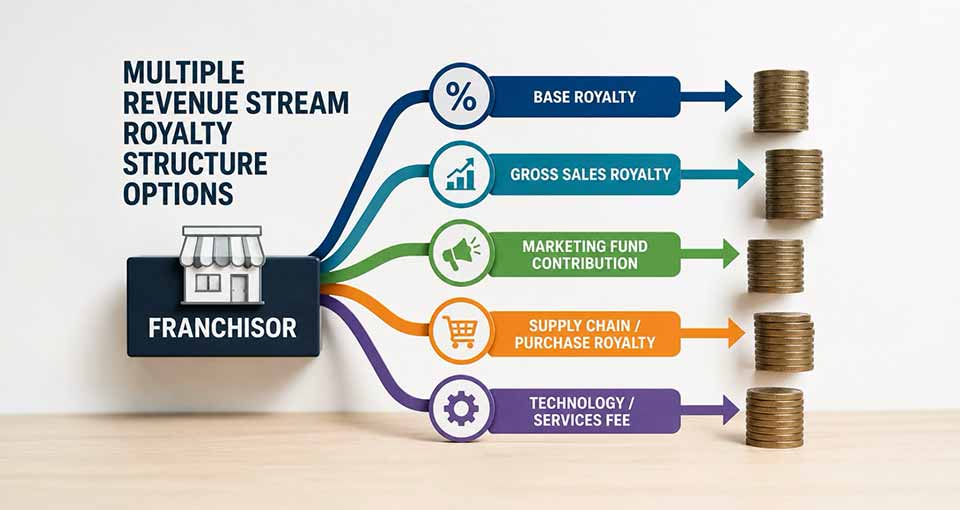
Beyond traditional royalties, franchisors often collect separate fees for marketing or advertising funds, typically ranging from 1% to 3% of gross sales. These contributions are pooled for national or regional campaigns that individual franchisees couldn't afford independently. Marketing funds enable brand-building initiatives, digital advertising campaigns, and promotional materials that benefit the entire system.
Effective marketing fund management requires transparency and accountability to maintain franchisee trust and participation. Many successful franchisors establish marketing advisory committees that include franchisee representation to ensure funds are used effectively. The collective purchasing power of pooled marketing dollars often delivers significantly better results than individual franchisee marketing efforts.
Technology Fees and Digital Services
Technology fees represent another common recurring revenue stream, often structured as fixed monthly charges for access to required software and digital tools. These fees typically range from $50 to $500 per month, depending on the complexity and value of the technology platform provided. Point-of-sale systems, inventory management software, customer relationship management tools, and online ordering platforms all represent potential technology revenue streams.
Digital services extend beyond basic software to include website hosting, online marketing tools, social media management platforms, and customer engagement systems. Many franchisors partner with technology providers to offer these services at competitive rates while generating additional revenue through volume discounts and service markups. The key lies in providing genuine value that improves franchisee operations rather than simply adding costs.
Minimum Royalty Requirements
Some franchisors implement minimum royalty fees to ensure a specific income amount, though this approach requires careful consideration of franchisee impact. Minimum royalties protect franchisors from underperforming locations while encouraging franchisees to focus on sales growth. However, these requirements can create financial strain for franchisees experiencing temporary sales challenges or operating in smaller markets.
When implementing minimum royalty requirements, successful franchisors typically start with modest amounts and provide clear pathways for franchisees to achieve sales levels that make percentage-based calculations more favorable. The goal is protection rather than punishment, ensuring system sustainability while supporting franchisee success.
Startup Period Adjustments
Many franchisors offer startup period adjustments, such as waiving or reducing royalty fees for an introductory period, to help new franchisees establish their businesses. These adjustments recognize that new locations require time to build customer bases and achieve steady sales volumes. Common structures include royalty-free periods for the first 30-90 days, followed by gradual increases to full royalty rates.
Startup adjustments demonstrate franchisor commitment to franchisee success while acknowledging the realities of business development timelines. However, these programs must be structured carefully to avoid creating dependency or unrealistic expectations about long-term operational costs. Clear communication about adjustment timelines and expectations helps maintain positive franchisor-franchisee relationships.
Diversified Revenue Streams Drive Superior Business Resilience
Multiple revenue streams provide franchisors with more robust and adaptive business models that mitigate risks and position franchise systems for long-term success. Research shows that businesses with diversified revenue streams are 30% more likely to maintain profitability during economic downturns compared to single-offering businesses. This resilience becomes particularly valuable during market fluctuations or industry disruptions.
Consider the success of Dustin Myers, a multi-unit operator of Batteries Plus stores, who achieved over $100 million in sales by building three key revenue streams: in-store retail, B2B sales, and device repair services. This diversification strategy protected his business during economic uncertainty while creating multiple growth opportunities. Franchisors who build similar diversification into their systems provide franchisees with improved stability and growth potential.
The strategic implementation of multiple revenue streams requires careful balance between franchisor profitability and franchisee success. Each revenue component should provide clear value to franchisees while contributing to system growth and sustainability. When structured properly, diversified revenue models create win-win scenarios where increased franchisor income directly correlates with improved franchisee support and business success.
For new and emerging franchisors seeking to develop profitable and sustainable revenue structures, Franchise Growth Partners offers consulting services to design and implement optimal royalty and fee strategies.