Your Strategic Partner in Franchise System Development.
Learn how to Franchise a Business Profitably.
Call us at: 1-800-471-1682Learn how to Franchise a Business Profitably.

Summary
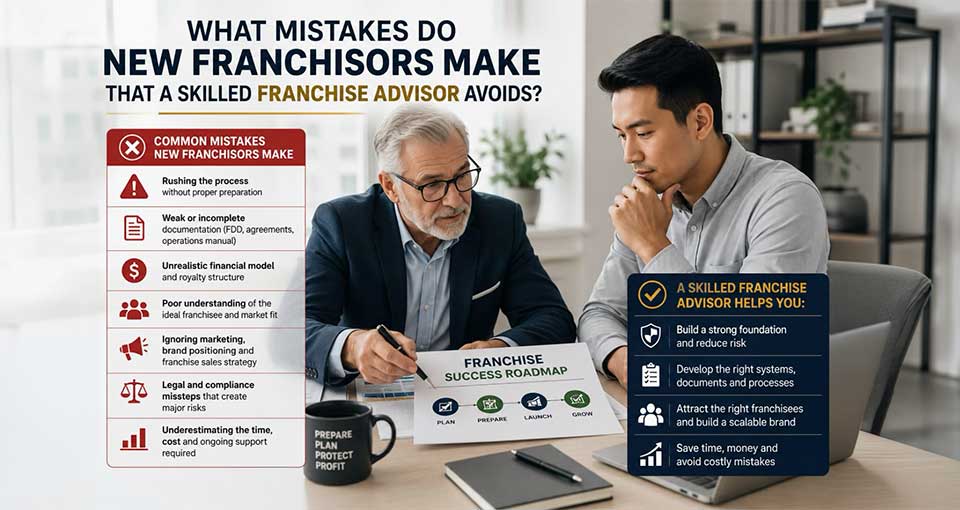
Most new franchisors crash within the first year, and the mistake that kills them isn't usually obvious until it's too late. A single error in your Franchise Disclosure Document can trigger lawsuits that cost more than your entire launch budget.
Key Takeaways
Franchising a successful business sounds straightforward: document what works, sell licenses, collect royalties, and grow. In practice, the gap between a great business and a great franchise system is where most new franchisors quietly fall apart. The mistakes are rarely dramatic at first - they show up as cash flow shortfalls six months in, a franchisee lawsuit over a vague agreement, or a brand diluted by a handful of poorly selected operators. Understanding where those gaps appear, and how experienced advisors close them, is the first step toward building a franchise that actually scales.
A proven business model is not the same thing as a scalable franchise system. Many entrepreneurs assume that because their original location runs smoothly, franchising is simply a matter of writing things down and finding buyers. What they quickly discover is that franchising is a separate business altogether - one that requires its own financial plan, legal framework, operational infrastructure, and sales process. Without that foundation in place before the first franchise is sold, every problem that surfaces gets compounded across every unit in the system.
The compounding effect is what makes early mistakes so damaging. A flaw in the FDD, a gap in training, or a vague royalty structure does not just affect one franchisee - it affects every agreement signed under that flawed framework. This is precisely why the planning stage deserves far more attention than most new franchisors give it. Advisors at Franchise Growth Partners note that franchisors who skip foundational planning often find their Franchise Disclosure Document deficient before it is even drafted, a costly position to be in.
Jumping into franchising without a high-level strategic plan is one of the most common - and most expensive - mistakes a new franchisor can make. A strategic plan defines expansion targets, competitive positioning, franchisee profiles, and milestones for reaching profitability. Without it, growth becomes reactive rather than intentional, and reactive growth rarely produces consistent results.
A financial plan is the roadmap that determines whether the franchise company itself survives its launch stage. New franchisors need to calculate the full cost of marketing, selling, and operating the franchise system, not just the initial franchise fee revenue coming in. Many first-time franchisors build projections around royalty income alone and then find themselves cash-strapped when the real operational costs arrive. A detailed financial plan, built before the FDD is drafted, prevents the system from being priced in a way that is structurally unprofitable from day one.
A well-developed franchise operations manual is the backbone of quality control across a franchise system. It sets the standard for how franchisees are trained, how day-to-day activities are managed, and how the brand is protected at the unit level. New franchisors who skip or rush this step end up with inconsistent franchisee experiences, uneven customer outcomes, and a brand identity that varies location by location. Maintaining and enforcing the operations manual is an ongoing responsibility that scales with the system.
The legal side of franchising is where the stakes are highest and where the consequences of cutting corners are most severe. Federal law requires franchisors to provide a compliant FDD to every prospective franchisee before any sale is made. Several states require registration and additional disclosures. Getting any of this wrong - even unintentionally - can result in rescission claims, regulatory fines, or litigation that costs far more than the legal fees saved by skipping qualified counsel.
One of the most common legal pitfalls is having the FDD prepared without the involvement of a qualified franchise attorney. Non-attorneys preparing legal disclosures, or general business lawyers unfamiliar with franchise law, frequently produce documents that fail to meet FTC requirements or state registration standards. The FDD is also a living document - it must be updated annually and whenever material changes occur. A deficient FDD does not just create compliance risk; it signals to sophisticated franchise candidates that the system is not ready.
Franchise agreements pulled from generic templates or adapted from another brand's documents create a different kind of problem. These agreements may fail to reflect the actual structure of the business - territory definitions, royalty calculations, renewal terms, and transfer rights all need to be tailored to the specific franchise model. A boilerplate agreement that does not align with the franchisor's growth strategy can create enforcement problems down the road and expose the brand to disputes that a properly drafted agreement would have prevented entirely.
The initial franchise fee is visible and easy to plan around. What surprises many new franchisors are the ongoing costs that do not appear in simple projections: franchisee support, marketing fund contributions, technology platforms, compliance management, and the salaries or service fees required to deliver consistent support at scale. When these costs are not modeled accurately before the system is priced, franchisors either underfund their support operations or squeeze margins to a point that makes profitable growth impossible.
Beyond royalties and marketing fees, franchisors carry costs for site selection support, franchisee training, operations oversight, accounting, and brand development - all of which need to be funded continuously. First-time franchisors who price their royalty structure too low, or who underestimate their cost of support delivery, find themselves in a position where growth actually increases their losses rather than reducing them. Modeling these numbers accurately before franchising begins is the difference between a profitable franchise company and one that grows itself into insolvency.
Growth is the goal of franchising, but premature scaling is one of the fastest ways to destroy a brand. When franchisees are added faster than the support infrastructure can absorb them, training quality drops, response times slow, and the consistency that defines a good franchise experience disappears. The brand suffers at every unit, and dissatisfied franchisees - who have invested real money based on the franchisor's promises - become a litigation risk as well as a reputational one.
Franchisee selection is a brand-protection decision, not just a sales decision. Franchisees who do not align with the brand's values, who lack the operational capacity to execute the model, or who were approved simply because they had the capital create ongoing problems that ripple through the entire system. A single underperforming or non-compliant franchisee affects customer perception, other franchisees' morale, and the franchisor's ability to enforce standards system-wide. A structured, criteria-based selection process is the foundation of a healthy franchise network.
Selling a franchise carries a unique compliance profile, a defined legal process governed by the FDD, and significant long-term consequences for every candidate who signs. New franchisors who approach franchise sales without proper training often either over-promise to close deals - creating legal exposure - or under-present the opportunity and lose qualified candidates to better-prepared competitors. Effective franchise sales training covers compliance, lead generation, the structured discovery process, and candidate management. Getting this wrong does not just slow growth; it attracts the wrong franchisees and repels the right ones.
A skilled franchise advisor provides structured, system-level guidance that addresses every phase of franchise development simultaneously - before problems have a chance to compound.
Franchise Growth Partners operates as a full-service platform that combines consulting, legal documentation preparation, training, and support services in one integrated engagement. The practical benefit of this approach is continuity: the financial plan informs the FDD structure, the operations plan shapes the training program, and the growth strategy drives franchisee recruitment criteria. When these components are developed independently by disconnected advisors, gaps appear between them. When they are built together, they reinforce each other.
Legal documentation is handled through partnerships with expert franchise attorneys at pre-negotiated fixed rates - a meaningful cost advantage for emerging franchisors who would otherwise face unpredictable legal billing while managing a tight launch budget.
Five training certification programs - covering Marketing and Lead Generation, Franchise Sales, Operations Management, Financial Management, and CEO Leadership Development - address the skill gaps that cause the most operational problems in early-stage franchise systems. These are stage-appropriate programs built around the specific demands of running and growing a franchise company. Franchise sales training alone, which covers compliance, lead procurement, and the full sales process, addresses an area where new franchisors routinely make expensive and legally consequential errors.
Rather than building expensive internal teams for every support function, franchisors can access standardized services - commercial leasing, franchisee funding, cloud-based operations systems, accounting, and brand development - on demand. This allows emerging franchisors to deliver professional-grade support to franchisees without the capital outlay of hiring full internal departments. The result is a leaner cost structure during the growth phase, when cash flow discipline matters most.
Every mistake covered here carries a price tag - some in legal fees, some in lost franchisee revenue, some in brand damage that takes years to repair. A deficient FDD requires a costly rewrite and delays the entire launch. A poorly selected franchisee can generate litigation, negative reviews, and system-wide morale damage. A financial model that underprices the royalty structure can make growth structurally unprofitable from the start. The cost of experienced franchise guidance is fixed and predictable. The cost of the mistakes it prevents is not.
New franchisors who invest in the right expertise before their first franchise agreement is signed consistently outperform those who try to build the system while selling it. The foundation - strategy, legal, financial, operations - has to come first. Everything else follows from it.
For new and emerging franchisors ready to build that foundation the right way, Franchise Growth Partners offers a free initial consultation to help entrepreneurs understand exactly what a properly structured franchise launch looks like - and what it takes to get there profitably.