Your Strategic Partner in Franchise System Development.
Learn how to Franchise a Business Profitably.
Call us at: 1-800-471-1682Learn how to Franchise a Business Profitably.

Summary
Think your franchise training program is just about teaching basics? The difference between 85-94% franchise survival rates versus 50% independent business failure comes down to specific training components—and most franchisors are missing at least one critical element.
Key Takeaways
The franchise industry thrives on a simple premise: replicating success through proven systems and ongoing support. However, the gap between promising a business model and delivering sustainable results often lies in how well franchisors prepare and support their franchisees through structured training programs.
The stark contrast in success rates between franchised and independent businesses reveals the power of structured operational guidance. Studies indicate that around 85-94% of franchises remain open after five years, while nearly 50% of independent businesses fail within the same period. This significant difference stems from the systematic approach franchises take toward business operations, standardized processes, and ongoing support structures.
Operations manuals serve as the legal and practical foundation for franchise success, outlining mandatory systems and processes that franchisees must follow. While the full operations manual remains confidential, its table of contents must be included in the Franchise Disclosure Document (FDD), providing step-by-step guidance for everything from daily operations to crisis management. Franchise Growth Partners emphasizes that without proper foundational business planning and structured training programs, franchise systems risk operating unprofitably during critical launch phases.
The success gap between franchised and independent operations highlights why structured training programs represent more than educational initiatives—they function as business survival tools. Franchisees equipped with detailed operational blueprints avoid common startup pitfalls that derail independent business owners, from inventory management errors to customer service inconsistencies.
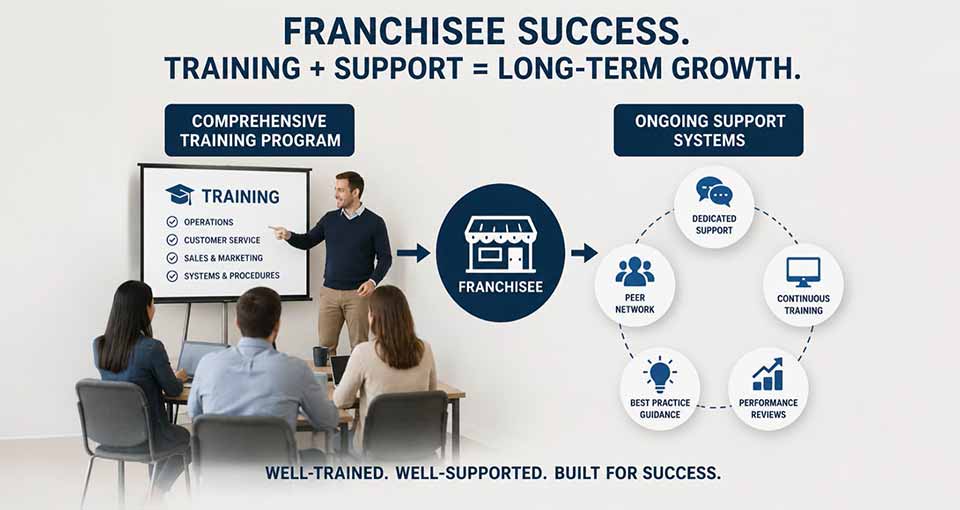
Effective franchise training programs focus on five critical areas that directly impact profitability and operational excellence. Each component addresses specific business functions while contributing to overall system consistency and growth potential.
1. Marketing and Lead Generation Fundamentals
Marketing training equips franchisees with proven strategies for attracting and converting prospects within their local markets. This component covers digital marketing fundamentals, local advertising techniques, customer acquisition costs, and brand-compliant promotional materials. Franchisees learn to implement marketing campaigns that maintain brand consistency while addressing regional preferences and market conditions.
2. Sales Training for Consistent Performance
Sales training standardizes customer interactions across franchise locations, ensuring consistent service quality and conversion rates. This training covers sales scripts, objection handling, upselling techniques, and customer relationship management. Franchisees develop skills for building customer loyalty while achieving revenue targets that support both individual and system-wide profitability goals.
3. Operations Management Standards
Operations training establishes consistent service delivery, quality control measures, and efficiency standards across all franchise locations. This component addresses inventory management, staff scheduling, equipment maintenance, and workflow optimization. Franchisees learn to maintain operational excellence while adapting to local market demands without compromising brand standards.
4. Financial Management and Controls
Financial training provides franchisees with money management skills, including cash flow analysis, expense tracking, profit margin optimization, and financial reporting requirements. This component ensures franchisees understand key performance indicators, maintain accurate records, and make data-driven decisions that support long-term profitability.
5. Leadership Development for Growth
Leadership training prepares franchisees to build and manage effective teams while fostering positive workplace cultures. This component covers hiring practices, employee training, performance management, and succession planning. Strong leadership capabilities enable franchisees to scale their operations while maintaining service quality and employee satisfaction.
Beyond initial training, ongoing support systems provide franchisees with resources and guidance needed to handle changing market conditions and operational challenges. These systems reduce startup errors, accelerate profitability timelines, and improve customer satisfaction rates.
Modern franchise systems use cloud-based platforms to streamline operations, facilitate communication, and provide real-time performance monitoring. These systems enable franchisees to access training materials, submit reports, communicate with support teams, and track key metrics from any location. Cloud-based platforms also allow franchisors to monitor system performance and provide targeted assistance when needed.
Professional site selection services help franchisees secure optimal locations while avoiding costly real estate mistakes. Support teams provide market analysis, demographic studies, traffic pattern evaluations, and lease negotiation assistance. This support reduces location-related risks while ensuring new franchise units align with brand positioning and profitability requirements.
Regular compliance monitoring ensures franchise locations maintain brand standards while identifying areas for improvement. Support teams conduct site visits, mystery shopping evaluations, and performance reviews to maintain consistency across the system. This ongoing oversight protects brand reputation while helping individual franchisees address operational weaknesses before they impact profitability.
Inadequate training programs create cascading problems that threaten both individual franchise success and overall system growth. These deficiencies manifest in measurable ways that directly impact franchisor profitability and expansion potential.
SBA loan data indicates franchise loan default rates of approximately 20-25% over 7-10 years, with inadequate training identified as a significant contributing factor. Franchisees lacking proper preparation struggle with cash flow management, operational efficiency, and customer retention—problems that often lead to business failure. These failures damage the franchisor’s reputation while reducing royalty income and territory availability for future growth.
Insufficient training creates inconsistent customer experiences that undermine brand value and customer loyalty. When franchisees operate without standardized procedures, service quality varies dramatically between locations, confusing customers and weakening brand positioning. This inconsistency reduces customer lifetime value while making it harder for well-performing locations to compete effectively in their markets.
Successful franchise systems implement tactical business operations plans that detail day-to-day activities for training and supporting franchisees. These plans go beyond general guidelines to provide specific action items, timelines, and success metrics that keep franchise systems operating efficiently.
Tactical plans address common operational challenges before they impact performance, from seasonal staffing adjustments to inventory optimization strategies. They provide franchisees with decision-making frameworks that maintain brand consistency while allowing flexibility for local market adaptation. Well-designed tactical plans also include escalation procedures for addressing problems quickly, preventing small issues from becoming major operational disruptions.
The most effective tactical plans integrate all aspects of franchise operations, from initial training through ongoing support services. They establish clear communication protocols, performance expectations, and improvement processes that benefit both franchisees and franchisors. These approaches create sustainable competitive advantages that drive long-term system growth and profitability.
For franchisors seeking to develop structured training programs and support systems, Franchise Growth Partners provides consulting services, training certification programs, and ongoing support services designed to accelerate unit growth and improve profitability.